
- AI & Automation
AI & automation systems that remove busywork and scale execution
Cham designs automation and AI layers that make your business faster, more consistent, and easier to run — without turning it into a fragile “no-code spaghetti” mess.
Trusted by Thousands of Clients












- Foundation
AI doesn’t create competence, it amplifies your system
The fastest way to waste money is “AI-first automation” on a messy operation. We build the foundation, then add AI where it actually improves speed, quality, or conversion.
1) System + Data Foundation
We map your workflows, inputs, sources of truth, and permissions — then design a system that humans and machines can run consistently.
2) Workflow Automation Layer
Routing, follow-ups, handoffs, enrichment, notifications, and reporting — built as a reliable operating layer across your stack.
3) AI Guardrails + UX
Chatbots and AI helpers that know what to do, what not to do, and when to escalate — so your brand doesn’t get embarrassed.
- The Automation Loop
Automation works best as a system, not random “AI features”
You don’t need 50 automations. You need one operating loop that captures, routes, executes, measures, and improves.
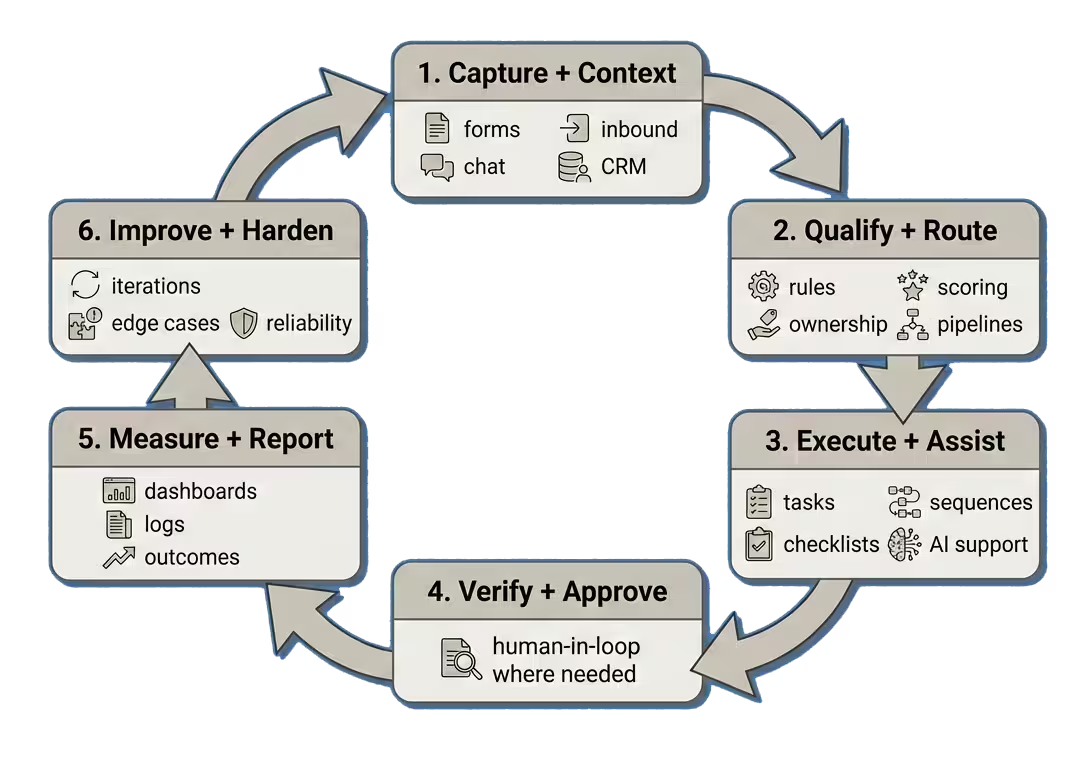
Automation isn’t “cool tech.” It’s controlled execution.
- Deliverables
What you actually receive
A coherent automation system — not scattered tools.
1) System Blueprint (Workflow Map)
Your current flow → improved flow, bottlenecks, ownership rules, and where automation creates leverage.
2) Architecture + Data Map
Sources of truth, integrations, permissions, and data fields — so the system stays clean.
3) Automation Build (Core Workflows)
Lead routing, CRM updates, follow-ups, internal notifications, task creation, handoffs, reporting.
4) AI Assistant or Chatbot (if included)
Website assistant, support deflection, lead qualification, internal helper — tuned to your voice and boundaries.
5) Guardrails Pack
Tone rules, escalation triggers, forbidden topics, approvals, fallback flows, risk boundaries.
6) Knowledge Base / Training Content (if needed)
Structured content that the assistant can safely use (and that humans can maintain).
7) Reliability + QA Checklist
Test cases, edge scenarios, monitoring points, and “break-glass” actions.
8) Documentation + Handover
You own accounts, workflows, prompts, and documentation — with a clean handover pack.
9) Reporting Snapshot
Baseline vs post-launch performance markers (response time, resolution time, lead speed, conversion friction).
- Investment
AI & automation for serious operations
We scope based on outcomes, risk, and complexity — not “number of zaps” or “chatbot installs.” Proposal-based beyond the minimum.
Proposal based
Minimum engagement: $6,000
How we determine pricing
- Starting point (new automation build vs fixing a broken system)
- Objectives (lead ops, support, fulfillment, reporting, content ops)
- Stack complexity (CRM, helpdesk, data sources, permissions)
- AI surface area (chat, routing, generation, evaluation)
- Volume + reliability needs (traffic, tickets, lead flow)
- Compliance sensitivity (finance, medical, legal, etc.)
- Timeline urgency
Included in all AI & Automation Projects
- System baseline + workflow mapping (fast, focused)
- Architecture + data map (sources of truth + access control)
- Build plan + implementation checkpoints
- AI guardrails (tone, escalation, approvals, risk boundaries)
- QA + monitoring checklist (so it doesn’t break quietly)
- Documentation + handover pack (you own the system)
- Fit Check
Built for serious offers
If you need automation, trust, and operational speed that matches your pricing — you’ll fit. If you want shortcuts — you won’t.
✅ Good fit if…
- You sell a premium service/product and need operations to match
- You want clean systems, not random automations
- You can provide access, data, and decision-making quickly
- You want documentation and ownership (not dependency)
- You care about reliability, guardrails, and brand safety
✕ Not a fit if…
- You want the cheapest “automation package”
- You expect instant results without cleanup or structure
- You want chaotic daily changes with no process
- You want AI to replace responsibility (no approvals, no rules)
- Decisions come from a committee that never commits
Not sure? Apply anyway — you’ll get a clean yes/no and a scoped proposal if it’s a match.
- Process
How the Project Runs
Clear checkpoints. Fast decisions. Production-ready outputs.
We extract objectives, current flow, bottlenecks, and failure points.
We define sources of truth, fields, permissions, and routing rules.
We implement the highest-leverage flows first (routing, follow-ups, handoffs, reporting).
We add assistants/chatbots where they improve execution — with strict boundaries.
Test cases, edge scenarios, monitoring points, and go-live checklist.
We review what’s working, harden reliability, and iterate based on real usage.
- Engagement Options
Different scopes, depending on what you need
Engagement
Primary goal
Integrations
Use Cases
- Case Studies
Operational outcomes that compound over time
AI is only valuable when it improves execution and reduces friction in the real world.
Launching a SaaS Startup’s Authority Engine: Website, PR & Automation
Technology & SaaS

- 37% reduction in repetitive support tickets
- 34% shorter sales cycle from first demo to close
- +48% uplift in trial-to-paid conversion rate
- Outcome Summary: The startup moved from early-market obscurity to a launch-ready authority system, with a clearer brand, conversion-focused website, PR proof, and automation creating momentum from day one.
Positioning a Luxury Real Estate Group as a Market-Dominant Authority
Real Estate & Property

- 37% faster time-to-first-response
- 68% of all leads automatically pre-qualified
- 54% higher close rate from website-originating leads
- Outcome Summary: The real estate group moved from a generic broker presence and noisy inquiries to a premium authority brand with pre-qualified demand, stronger local visibility, and a more efficient high-ticket sales pipeline.
Scaling a National Retail Brand Through SEO, Conversion Design & Automation
E-commerce & Retail

- First-response time: 11 minutes → 45 seconds (median)
- Support tickets per 1,000 orders: 410 → 242 (–41%)
- Blended customer acquisition cost: –24%
- Outcome Summary: The apparel brand moved from paid-media dependence and support overload to a search-led, conversion-optimized e-commerce engine, with automation reducing friction across the customer journey.
- Why Cham
Cham vs typical agencies
Typical agencies
- Sell “AI automations” without fixing the system
- Build fragile flows with no documentation
- Focus on tools instead of outcomes and reliability
- Leave you dependent on them to maintain everything
- Ignore guardrails → brand risk later
Cham
- System-first architecture, then automation, then AI
- Structured workflows with ownership and documentation
- Guardrails + escalation rules built-in
- Reliability, QA, and monitoring checkpoints
- Built to compound: faster ops, cleaner data, better conversion
Before Cham, we were doing ‘automation’ the way most teams do it: half-broken Zapier chains and a Slack channel full of exceptions. Cham rebuilt the flow end-to-end, documented the logic, and added human checkpoints where it actually matters. Now it runs quietly in the background, which is the point
Arman Vaziri
COO, B2B SaaS
If you’re serious about automation, we’ll scope it properly
Tell us what you sell, what’s manual today, and what outcome you want. If it’s a fit, you’ll get a scoped proposal — not vague promises.
- FAQ
Frequently Asked Questions
1. What’s the difference between automation and AI?
Automation executes rules. AI handles language and judgment — but it must be constrained. We use automation for reliability and AI where it adds real leverage.
2. Do you guarantee results?
No one can honestly guarantee outcomes without controlling your offer, traffic, team, and decision-making. We guarantee clean architecture, build quality, documentation, and a system designed to improve measurable operational KPIs.
3. What tools do you build with?
We work with the stack that fits your operation: Make/Zapier/n8n, CRMs, helpdesks, WordPress/Webflow/Shopify, and data tools. Reliability and ownership come first.
4. Can you build a chatbot for my website?
Yes — but only with guardrails: knowledge boundaries, escalation rules, tone controls, and safe fallback behavior.
5. How long does it take?
Most builds run in phases. A focused scope can move fast; complex stacks and multiple workflows take longer. You’ll get a timeline in the proposal after baseline mapping.
6. Will we own the system?
Yes. Client-owned accounts, documentation, and handover are standard. We don’t build dependency.
7. Can you automate content creation?
Yes — but we design it as an ops pipeline with approvals and quality control. The goal is speed without lowering standards.
8. What about security and access?
We follow least-privilege access, keep data handling clear, and design kill-switch and escalation behavior. Sensitive environments require stricter constraints.
9. Can you connect everything to my CRM and pipeline?
That’s a core use case: routing, enrichment, follow-ups, task creation, and clean reporting.
10. Do you offer ongoing monitoring?
Yes. Automation systems degrade if nobody watches them. Retainers are available for monitoring, iteration, and adding new workflows.